Who Killed Francis Charles Kennedy
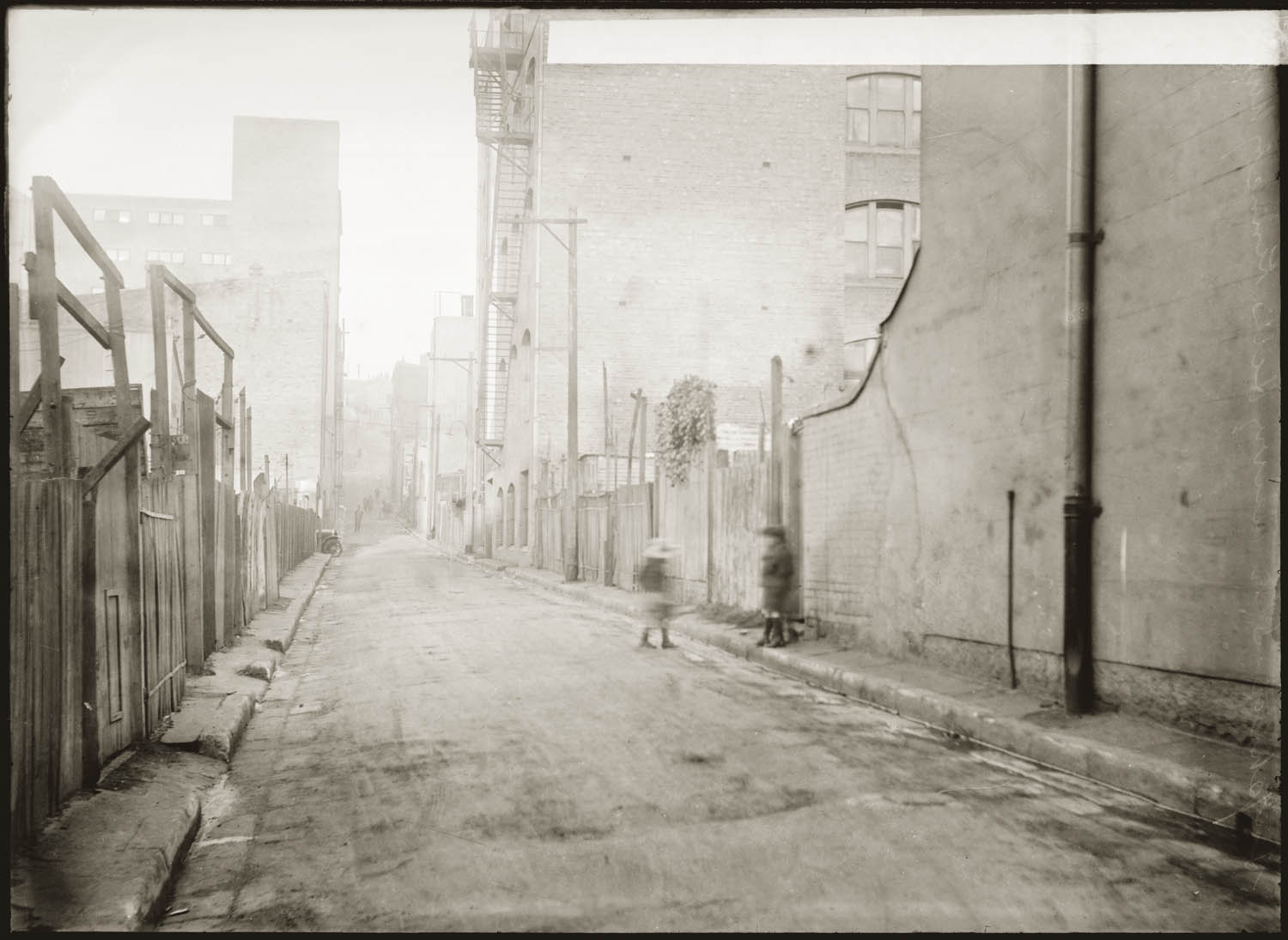
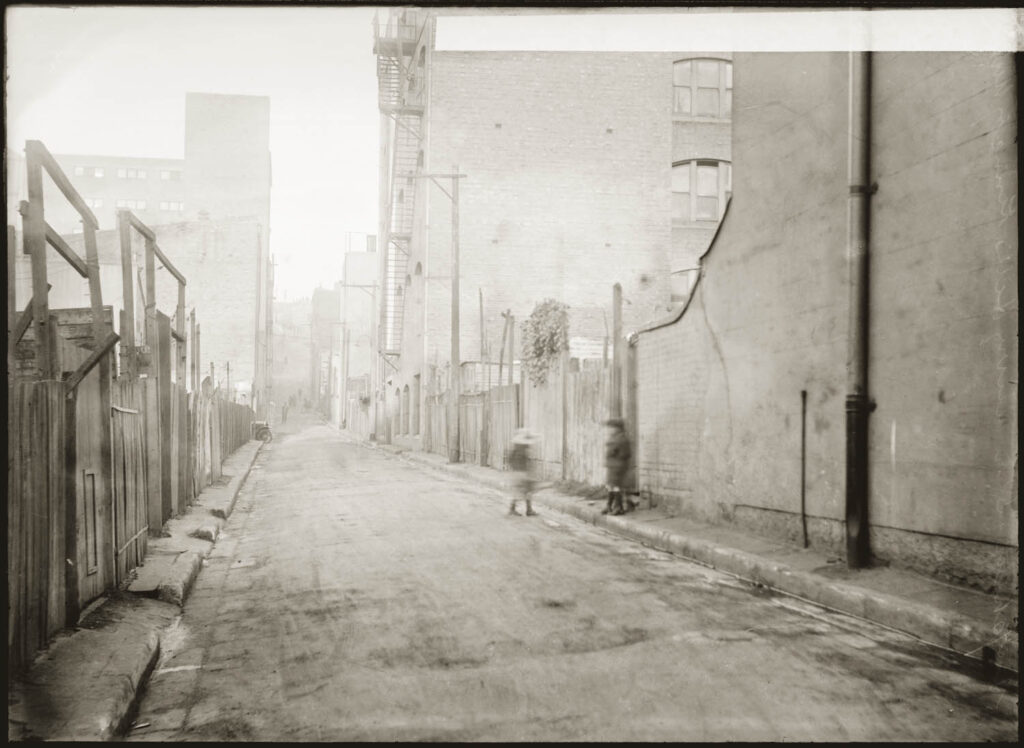
Sophia Street, Surry Hills, 1922.
By Elliot Lindsay
On the wet evening of Saturday 17 June 1922, Francis Charles Kennedy left his wife and children at their home in Orpington Street, Ashfield, and travelled towards the city. Kennedy was forty-five years old and employed as a railway porter. Nothing in the surviving accounts suggests that his departure was unusual, yet his movements over the following hours would become the central mystery of one of Sydney’s most perplexing murder investigations. By midnight he lay dead in a narrow vehicle dock off Sophia Street, Surry Hills, only a short distance from Central Railway Station. His skull had been fractured, his pockets had been emptied and turned inside out, and his personal belongings lay scattered around him in the rain.
Within days, detectives believed they had identified those responsible. Frederick Reardon and his sister, Esther Eggers, were arrested and charged with Kennedy’s murder. At the Coroner’s inquest, witnesses described robberies, bottle attacks and shadowy movements through the narrow streets of western Surry Hills. The Coroner returned a finding of wilful murder against Reardon and Eggers and committed them for trial. Yet the case never reached a murder jury. The Attorney-General declined to file an indictment, concluding that the evidence presented at the inquest was insufficient. Reardon and Eggers were later convicted of assaulting an unidentified man, but that assault was never shown to have involved Kennedy.
At the heart of the failed murder case stood May Smith, a dressmaker who lived near the intersection of Terry and Foveaux Streets. Smith claimed to have watched Reardon and Eggers attack a man on the night Kennedy died and later saw them walking near the place where his body was discovered. Her testimony appeared, at first, to connect the accused to the murder. Closer examination, however, reveals serious problems. She could not identify the man she saw as Kennedy. Her account of his behaviour after the assault was incompatible with the medical evidence surrounding Kennedy’s death. Her observations conflicted with aspects of another witness’s story, and several of her most damaging allegations were unsupported by independent testimony. The police and the Coroner treated her evidence as the foundation of a murder case, but the Crown ultimately prosecuted the incident she described as an assault upon a person whose identity remained unknown.
The Barbary Coast
To understand the investigation, it is necessary to appreciate the character of Sophia Street and its surrounding neighbourhood in 1922. Contemporary police regarded the district as one of the most dangerous parts of Sydney and the northern gateway to what they colloquially referred to as the “Barbary Coast”—a labyrinth of narrow streets stretching through a crescent from western Surry Hills to Woolloomooloo that had acquired a reputation for vice, robbery and violence.
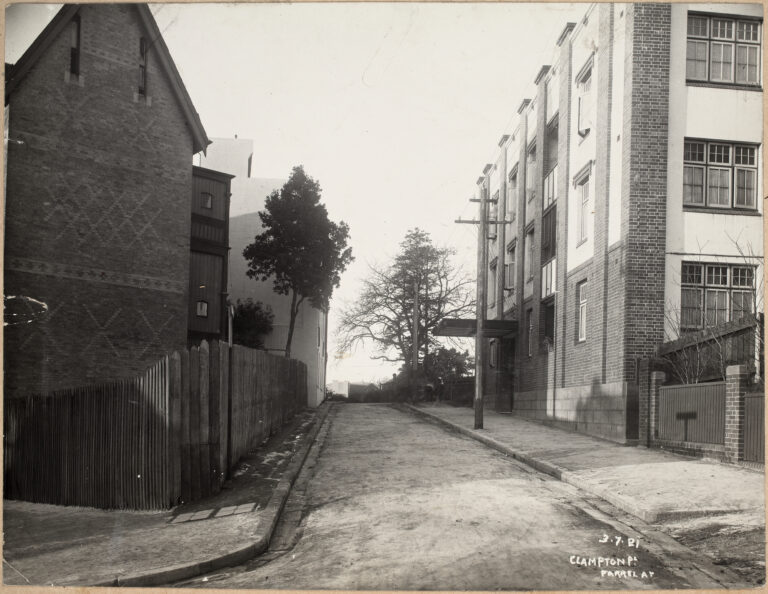
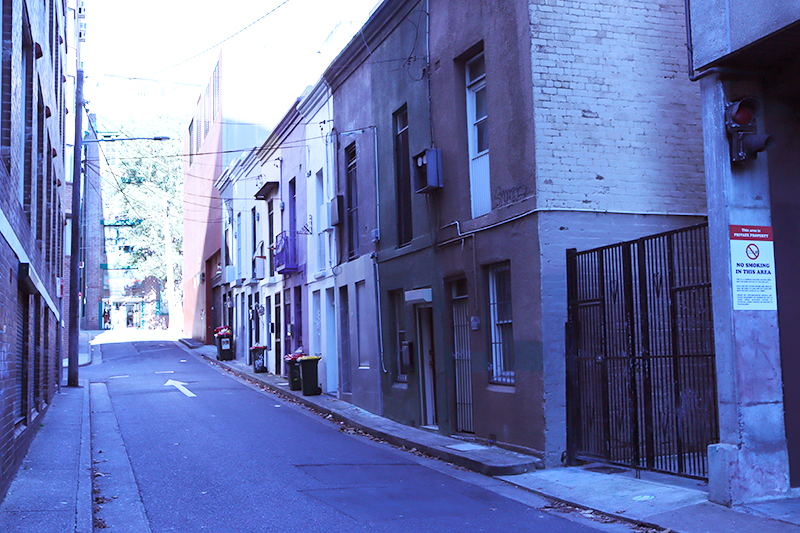
Sophia Street itself was particularly well suited to criminal activity. It was a long, enclosed street running between Riley Street and Elizabeth Street, although it had no direct access to Elizabeth Street. Instead, it formed a discreet thoroughfare linking Central Railway Station with Little Riley Street and the densely populated slum districts beyond, including Frog Hollow and Strawberry Hills. The street provided an inconspicuous route through a neighbourhood where thousands of railway workers, labourers, factory employees and late-night drinkers mingled with criminals, prostitutes and illegal gambling operators.
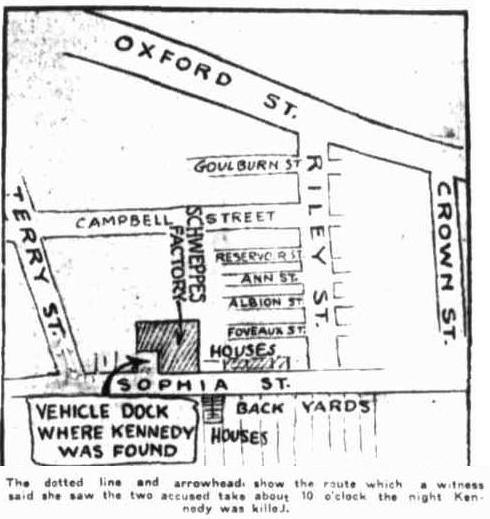
The district also retained a strongly industrial character dating back to the nineteenth century. Terry Street continued north across Foveaux Street through the former Toohey’s Standard Brewery precinct, while Sophia Street functioned largely as a service lane for surrounding factories, including the Schweppes bottling works, a substantial boot factory and the emerging Surry Hills garment district. Warehouses, loading docks and commercial yards dominated much of the streetscape. Many of the older terraces and cottages occupied low-lying ground prone to flooding and poor drainage. By the early 1920s these dwellings were widely regarded as insanitary, and many were later resumed and demolished as part of Sydney’s slum-clearance programmes.
The neighbourhood surrounding Kennedy’s murder was also one of Sydney’s principal centres of illicit activity. Within a short walk of the crime scene stood at least six hotels, while numerous sly-grog shops operated behind otherwise respectable premises. Illegal gambling flourished. Several two-up schools, including the notorious Tommo’s Two-up School, operated nearby, and only weeks before Kennedy’s death police had raided a two-up school in Terry Street for the twenty-seventh time, arresting fifty-seven men. Chinese fan-tan houses and opium dens were also established in the locality, while contemporary newspapers regularly identified Sophia Street and its adjoining lanes as a favourite haunt of local push gangs and street robbers.
Against this backdrop, Kennedy’s murder was not viewed by police as an isolated act of violence but as another crime committed within one of Sydney’s most notorious criminal environments. The district’s reputation undoubtedly shaped the investigation from the outset. Detectives assumed that the attack was the work of local offenders already known to police. Whether that assumption ultimately assisted or hindered the investigation remains one of the central questions surrounding the Sophia Street mystery.
A Body in the Rain
Kennedy’s body was discovered late on Saturday night in a dark vehicle dock adjoining the Schweppes factory on Sophia Street. The dock was a recessed loading space associated with the commercial buildings clustered west of Elizabeth Street and south of Central Railway Station. Although geographically close to the bright thoroughfares and railway platforms of central Sydney, the surrounding neighbourhood contained narrow lanes, poorly illuminated corners, lodging houses, factories and drinking establishments. Newspaper reports repeatedly portrayed it as a district in which robbery and violence flourished after dark.
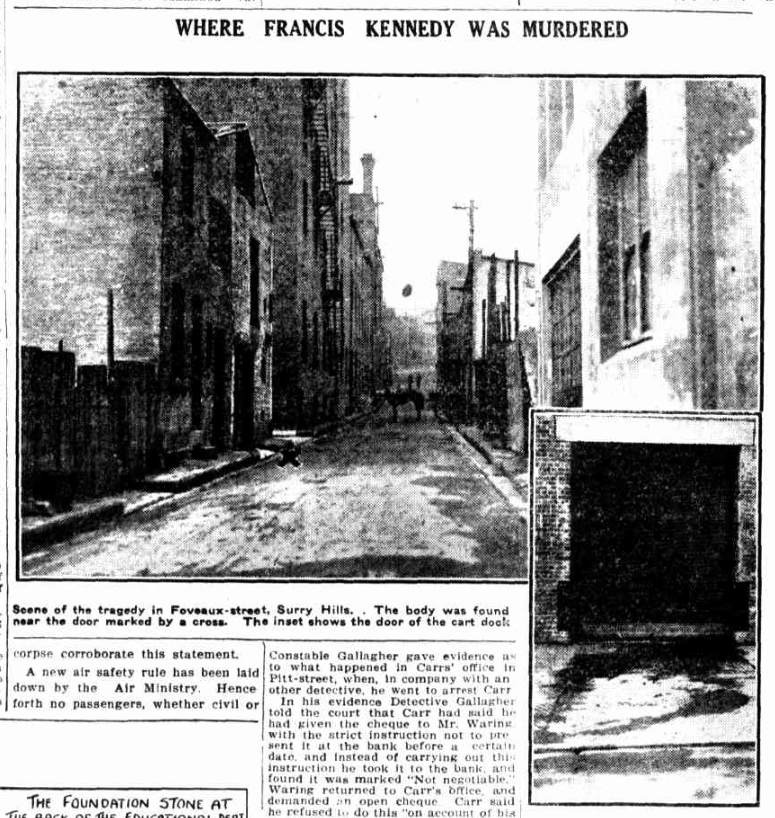
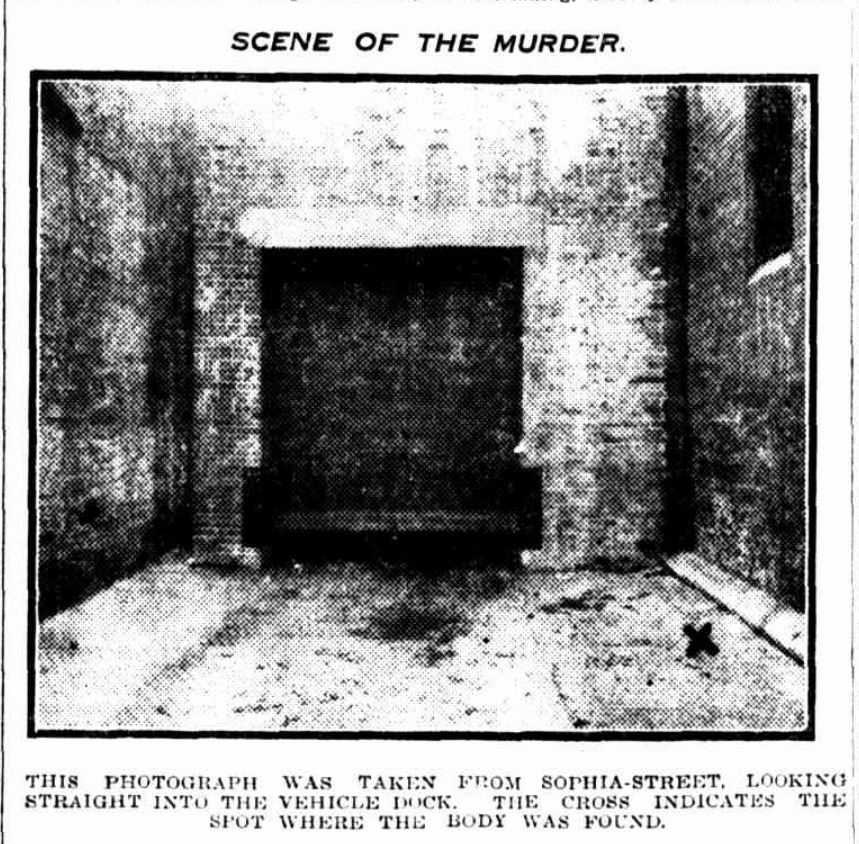
A man named John Derley, or Durley in some reports, approached the Regent Street police station and stated that he had seen a man lying in the dock. Constables went to the location and found Kennedy stretched on his back, his arms extended. His body was cold, and his clothes were wet with rain and blood. His pockets had been turned inside out, while papers, a pipe, railway uniform buttons and other items were scattered over the ground. The scene immediately suggested that he had been robbed.
Police also found broken glass near the body, including the neck of a beer bottle with its capsule still attached. The bottle neck was preserved as a possible source of fingerprints, although the Crown representative conceded at the inquest that there was then nothing connecting it with Reardon or Eggers. Its presence was suggestive, but hardly conclusive. Defence counsel pointed out that drinking, sly-grog trading and two-up schools were common in the neighbourhood, making broken bottles an ordinary feature of the locality rather than evidence that could be linked automatically to the murder.
Dr Stratford Sheldon conducted the post-mortem examination. Kennedy had suffered a jagged wound on the right side of his jaw and a severe fracture to the skull. The wound beneath the jaw could have been inflicted with a beer bottle, a fist or another blunt object. Sheldon believed Kennedy may have been struck and then fractured his skull when he fell onto the concrete floor of the dock. The fracture and laceration of the brain caused his death. There was also fluid in his stomach that smelled of beer, and the doctor detected the odour of alcohol on the body.
The medical evidence established the probable mechanics of Kennedy’s death but did not identify his attacker. He had apparently been struck once, fallen heavily and remained where he landed. There was no evidence that he recovered consciousness, stood up, walked away or sought help after the fatal blow. This detail would later become crucial when May Smith’s account was compared with Kennedy’s injuries.
Kennedy’s Missing Hours
One of the greatest mysteries surrounding the Sophia Street murder concerns Francis Kennedy’s movements during the hours before his death. Although the police reconstructed much of the investigation after his body was discovered, they were never able to establish with certainty where he had been, whom he had met, or why he entered the streets east of Central Railway Station on the night of 17 June 1922. These unanswered questions would haunt the investigation from beginning to end.
According to his widow, Hannah Kennedy, her husband had been asleep when she last saw him during the afternoon. At about six o’clock their son discovered that he had quietly left the house. Initially, Mrs Kennedy assumed he had gone to Summer Hill for a drink, as he occasionally did. Her son, however, recalled that his father had remarked before leaving that he would probably give him £1 when he returned home. This prompted Mrs Kennedy to reconsider his destination. She told reporters that Kennedy had travelled into Sydney approximately three weeks earlier to collect the proceeds of a successful wager and believed he may have been making a similar journey on the evening of his death. She emphasised that her husband was neither a habitual gambler nor a drunkard. He occasionally placed small bets, she said, but gambling played only a minor part in his life. Likewise, he was not a heavy drinker, although she remarked that only “two or three glasses of ale” were enough to make him muddled.
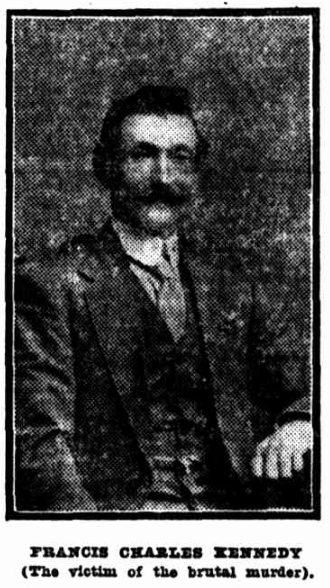
Mrs Kennedy’s reconstruction was entirely speculative, but it represented the only explanation ever offered for her husband’s presence in the city that evening. She believed he may have collected his winnings, stopped for a few drinks and, while attempting to return to Central Railway Station, lost his bearings and wandered into Sophia Street. Whether this actually occurred was never established. No bookmaker came forward to confirm that Kennedy had collected money that evening, no witness recalled seeing him place or receive a bet, and no one could account for his movements after he left home.
The absence of reliable sightings proved to be one of the greatest obstacles confronting detectives. Kennedy was believed to have travelled towards the city during the early evening and was thought to have arrived at Central Railway Station at approximately 7.33 p.m., but after that the trail went cold. No witness placed him in the company of Frederick Reardon or Esther Eggers. No one saw him enter the cart dock where his body was eventually discovered. Indeed, contemporary newspapers openly acknowledged that his whereabouts after leaving Ashfield were unknown. As Truth observed following the Coroner’s inquest, “What poor Kennedy was doing in the dangerous locality on the fateful night, and how he came to be there, are problems which cannot be solved.”
This uncertainty fundamentally weakened the prosecution’s case. Had detectives been able to establish where Kennedy spent the evening, who last saw him alive, or whether he had indeed collected betting winnings, they may have reconstructed his final journey with much greater confidence. Instead, they were forced to infer his movements from unrelated robberies and assaults occurring elsewhere in western Surry Hills. The result was an investigation built largely upon circumstantial evidence, leaving the most basic question unanswered: why was Francis Kennedy in Sophia Street at all?
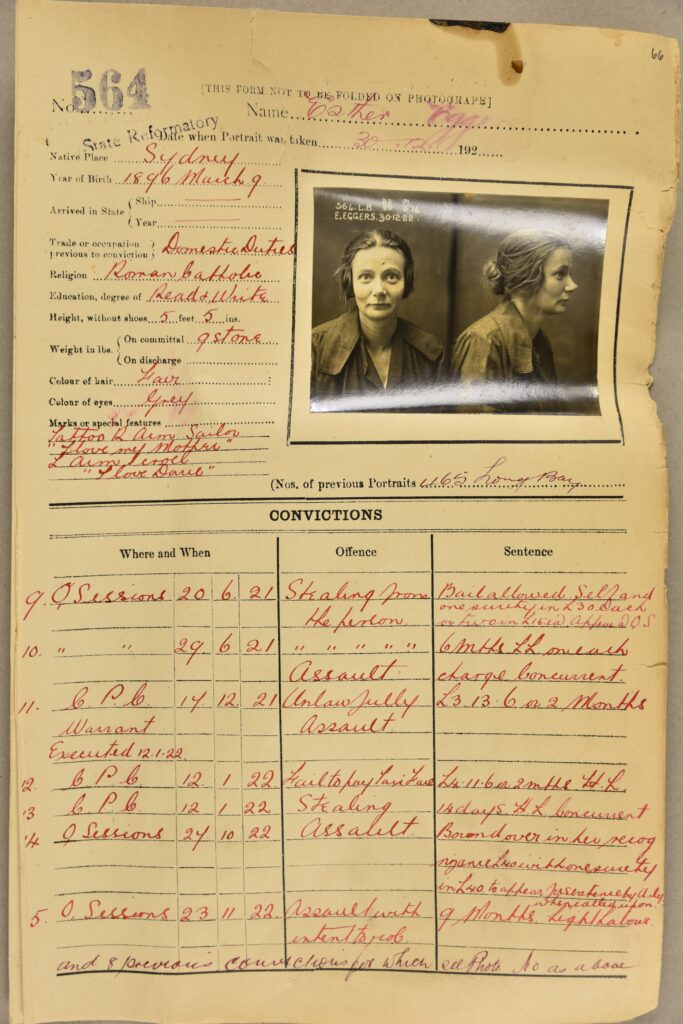
Frederick Reardon and Esther Eggers
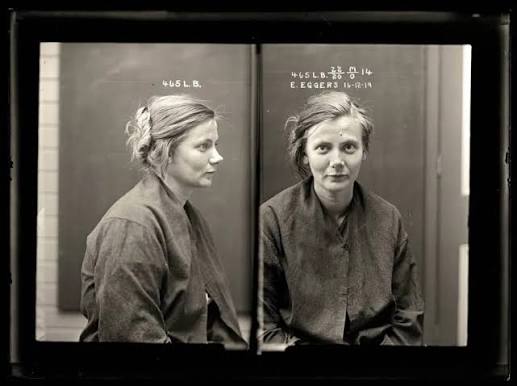
Frederick Reardon was described as a clean-shaven man of thirty-two. Esther Eggers, sometimes identified as Esther Reardon, was described as his sister. Both were known to police and associated in the press with the street life of Surry Hills. Detectives arrested Reardon at Maroubra. One officer testified that, before being told the reason for his arrest, Reardon remarked, “I suppose it is for the Surry Hills murder.” The statement was presented as suspicious, though knowledge that police were investigating him may have circulated through the neighbourhood before his arrest.
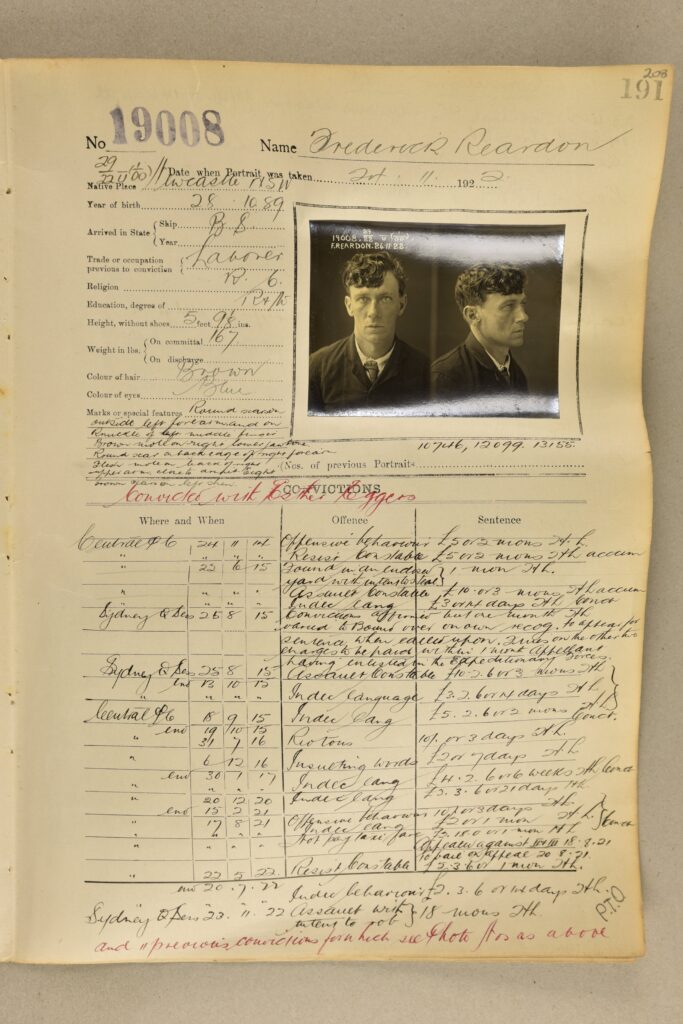
Reardon initially claimed that, after drinking during the afternoon, he returned to the Federal Coffee Palace or lodging house in Castlereagh Street between 7 and 8 p.m. Harold Dixon, the manager, contradicted him. Dixon stated that Reardon did not return until approximately 10.45 p.m. and was then drunk. This discrepancy damaged Reardon’s alibi and left him unaccounted for during the period in which both the assault witnessed by Smith and Kennedy’s death may have occurred.
Eggers also gave police an account of her movements. According to Sergeant McKnight, she later indicated that her first statement had been false and that she wished to make another after speaking to William Williamson, an associate who claimed to have been with her until 11 p.m. She subsequently refused to provide a fresh account before consulting her solicitor. The Crown treated her hesitation and the contradictions between the various statements as suspicious. Nevertheless, a person’s refusal to make a further statement after seeking legal advice could not itself prove participation in a murder.
The most damaging physical evidence was Kennedy’s notebook. Detective Rufus Fowler testified that it was discovered among papers taken from Reardon during a search at the police station. When informed that Mrs Kennedy had identified the notebook, Reardon allegedly began to cry and said, “I want to tell you something.” When the detective returned, Reardon changed his mind, saying that it might be better not to speak at that stage. He did not, according to Fowler, deny that the notebook had been in his possession. The circumstances were highly suspicious, but the notebook alone could not establish that Reardon had killed Kennedy. It might have been stolen from Kennedy before or after his death, passed to Reardon by another person, or acquired through some other unexplained transaction. The prosecution needed evidence connecting possession of the book to the fatal attack.
That connection was supposed to be supplied by May Smith.
May Smith of 25 Terry Street
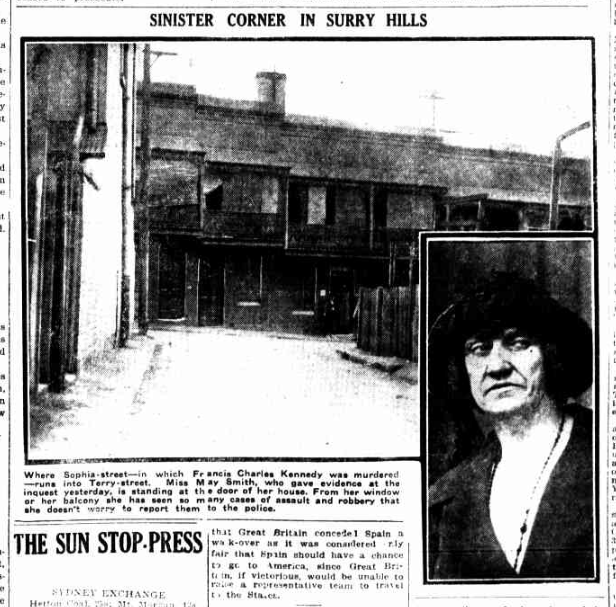
May Smith was a dressmaker who lived at 25 Terry Street, close to the intersections of Terry, Foveaux and Sophia Streets, referred to as “the sinister corner”. Her house gave her a view of a district she described as saturated with violence. She had lived there for approximately three years and earned her living sewing clothes. She also rented a room to a boot repairer.
At the inquest, Smith testified that around 8 p.m. on the night Kennedy died she saw Reardon and Eggers standing on opposite corners at the intersection of Terry and Foveaux Streets. Some time later—variously reported as approximately 8.30 or 8.50 p.m.—she saw Eggers struggling with a man. Smith could not say precisely what Eggers was doing. She thought Eggers either had an arm around the man or a hand inside his pocket. The man appeared to be trying to pull away.
Reardon then crossed the street and spoke to him. Smith said Reardon struck the man, who fell to the ground. At about the same moment, she heard the sound of breaking glass. She could not determine whether Reardon had struck him with his fist or with a bottle. She then allegedly heard Eggers call to Reardon, “Come on; I’ve got all I want.”
If accurate, this was compelling evidence of an attempted robbery and violent assault. It placed Reardon and Eggers together, portrayed Eggers as searching or restraining the victim, and described Reardon intervening physically. Eggers’s alleged remark suggested that something had been taken. The breaking glass appeared to echo the bottle fragments found near Kennedy’s body.
The difficulty was that Smith’s evidence did not establish that the victim was Kennedy.
The Man Who Got Up
The most serious problem in Smith’s story concerned what happened after the assault. She testified that the man remained on the ground for approximately twenty minutes, then disappeared. Later, he returned to the corner with a police officer, apparently searching for his assailants.
This could not easily be reconciled with Kennedy’s death. The medical evidence suggested Kennedy had suffered a catastrophic skull fracture and laceration of the brain. When police found him in the Sophia Street dock, his body was cold. Nothing indicated that he had recovered after the blow, walked away, found a policeman and returned to search for his attackers.
The man observed by Smith was evidently alive, mobile and capable of communicating with police. Kennedy was found dead in another location several hours later. For the Crown’s original murder theory to work, Kennedy would have needed to survive the Terry Street assault, recover sufficiently to leave the scene, return with a policeman and then suffer a second fatal attack in the Sophia Street dock. No evidence supported such a sequence.
Alternatively, the police may initially have assumed that Smith had seen Kennedy struck but failed to appreciate the significance of her statement that the victim later returned. Once the evidence was scrutinised by the Crown Law authorities, the contradiction would have been impossible to ignore.
The eventual prosecution confirms the problem. After the murder charge was abandoned, Reardon and Eggers were tried for assaulting a man whose name was unknown. The Crown did not identify that man as Kennedy. It effectively separated Smith’s assault from the homicide, conceding that the event she witnessed could not safely be treated as Kennedy’s murder.
Two Locations, Not One
Smith’s testimony also involved two distinct locations. The assault occurred near the intersection of Terry and Foveaux Streets. Kennedy’s body was discovered in a vehicle dock off Sophia Street. Smith did not claim that she saw Reardon drag, carry or lead the assaulted man towards the dock. Nor did she describe the victim moving in that direction after recovering.
Her second observation came later. At about 10 p.m., she said she saw Reardon and Eggers walking quickly down Sophia Street towards Terry Street. She estimated they were about fifty yards from the place where Kennedy’s body was found. This evidence placed them in the general vicinity, but only after the earlier victim had supposedly recovered and returned with a policeman.
Being fifty yards from the eventual crime scene was suspicious in the context of the accusations, but it did not establish that either person entered the dock or encountered Kennedy. Sophia Street and the surrounding lanes were populated urban spaces. The pair’s presence nearby could support a circumstantial case only if other evidence securely connected them to Kennedy. Without such evidence, the sighting proved little more than that two local figures were walking through their neighbourhood.
The precise direction of their movement also mattered. Some reports described them as coming down Sophia Street towards Terry Street. Depending on the location of the dock and Smith’s vantage point, they may have been approaching or moving away from the vicinity. The newspapers did not provide a sufficiently exact spatial reconstruction to determine this with confidence. What is clear is that Smith did not witness them entering or leaving the cart dock.
Smith’s Failure to Report the Assault
Defence counsel, R. E. Meagher, subjected Smith to a long and often theatrical cross-examination. One of his principal attacks concerned her failure to help the injured man or notify police.
Smith had allegedly watched a man struck to the ground, heard glass breaking and seen him remain there for twenty minutes. Yet she did not call out, approach him, provide water or walk to the nearby police station. Meagher asked whether her “refined womanly feelings” had compelled her to protest. Smith replied that they had not, because she feared being assaulted herself.
When asked why she did not report the incident, Smith explained that violence was so common in the neighbourhood that she would be continually visiting the police station if she reported every assault. When challenged over leaving a potentially injured man “like a dog,” she responded that it was not her business to pick him up. She feared that a drunken or confused victim might accuse her of having robbed him.
Her explanation was plausible within the violent environment she described, but it also created evidentiary difficulties. Because Smith did not report the event immediately, police could not identify the victim, record his injuries or establish whether the assault occurred exactly as she remembered. Her evidence emerged only after Kennedy’s death had generated a major investigation. The possibility of memory being influenced by subsequent events could not be excluded.
Smith’s apparent indifference also troubled observers because her later evidence was delivered with confidence and considerable detail. She could remember the accused, their positions, the struggle, the blow, the sound of glass and Eggers’s alleged words, yet she had not regarded the incident as sufficiently important to report at the time. The defence invited the jury to consider whether the account had grown in significance only after detectives began searching for evidence against Reardon and Eggers.
“If I Reported Every Assault”
The day after the inquest, the Sun interviewed Smith at her Terry Street home. She presented herself as a hardened but independent resident living amid almost constant disorder. She claimed that fights, robberies and bottle attacks regularly occurred outside her house and in nearby lanes. Victims were allegedly lured from the main streets, assaulted in the shadows and abandoned after their money was taken.
Smith said that if she ran to the police station whenever she saw someone knocked down and robbed, she would starve. “It’s either help the police or make dresses,” she explained. “You can’t do both in this place.” She also claimed to keep a firearm for protection and recounted several episodes in which she had confronted or observed violent offenders.
The interview is valuable as a contemporary description of the neighbourhood, but it must be treated cautiously. It was a sensational newspaper feature published immediately after Smith became a central witness in a notorious murder inquiry. The journalist emphasised the darkness of the lanes, the frequency of bottle attacks and Smith’s defiant personality. Her anecdotes may have reflected genuine experiences, but they also reinforced the image she had presented in court: a woman so accustomed to violence that she no longer considered an assault worthy of intervention.
Her explanation might account for her silence, but it did not resolve the contradiction between the unidentified man who recovered and Kennedy, who did not.
“A Dozen Times”
Under questioning from the Crown, Smith claimed that she had seen Reardon and Eggers commit assaults in the district on approximately twelve previous occasions. This allegation was extremely prejudicial. It implied that the accused had an established method of selecting, robbing and attacking men in precisely the manner she described.
Yet the newspaper reports do not identify the alleged victims, dates or circumstances of these twelve incidents. No corroborating witnesses were called to confirm them, and no convictions arising from those alleged assaults were presented at the inquest. Smith’s assertion therefore remained an unsupported allegation.
It also raises questions about her conduct. If she had repeatedly witnessed the pair assaulting people, why had she never reported them before Kennedy’s death? Her general explanation—that reporting every crime would consume all her time—might explain occasional silence, but the claim that she had watched the same identifiable pair commit a dozen attacks was more difficult to dismiss as routine neighbourhood disorder.
The allegation may have been true, exaggerated or influenced by the reputation of the accused. It undoubtedly helped persuade the Coroner, but it was not reliable evidence that they murdered Kennedy.
The Attack on Smith’s Character
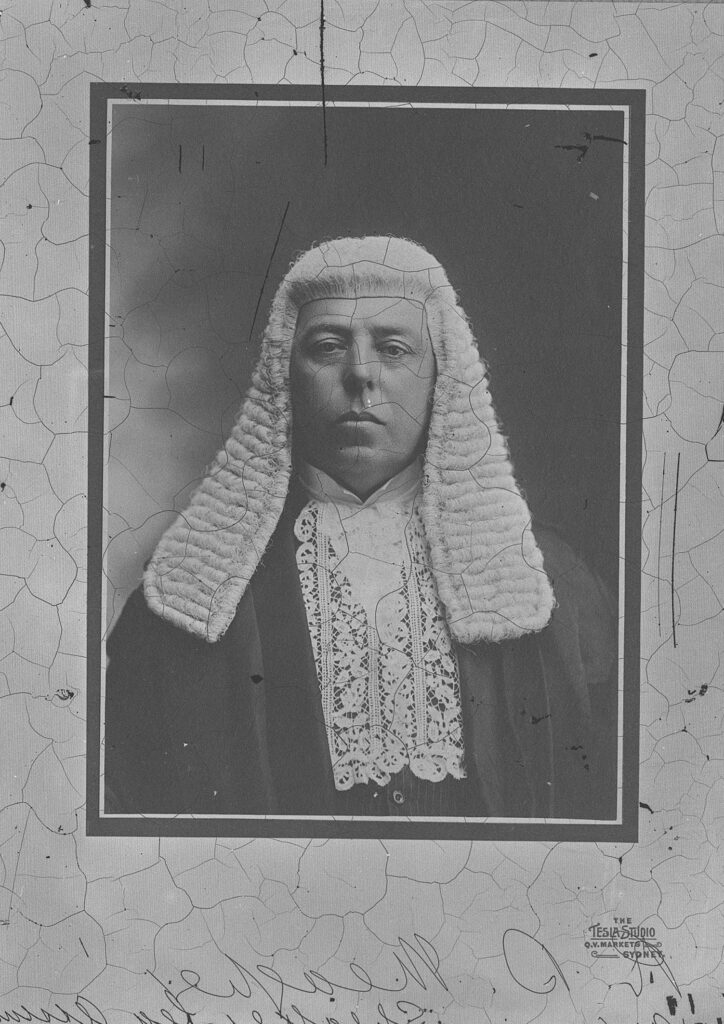
Meagher also attempted to discredit Smith by attacking her reputation and the character of her house. He asked whether Chinese men visited the premises, whether men and women attended together, and whether the house was known to police as a place used for immoral purposes. He also asked if she was known as “Botany May.”
Smith denied that her home was used for prostitution or other immoral activities. She said she supported herself through dressmaking and named customers for whom she had made clothes. She acknowledged having lived at Botany but did not accept that “Botany May” was a recognised alias.
The questions reveal the gendered assumptions operating in the courtroom. A working woman living alone or independently in a notorious district could easily be represented as disreputable. Meagher’s strategy was to suggest that Smith was not a respectable dressmaker observing crime from a distance but a participant in, or beneficiary of, the street culture she described.
Nothing in the reports demonstrates that these allegations were proved. Nevertheless, the cross-examination may have affected how jurors assessed her credibility. It also exposed a central tension in her presentation. Smith portrayed herself as socially separate from the criminal world outside her house, yet claimed extraordinary familiarity with its participants, methods and frequency of violence.
Esther Eggers’s Outburst
Smith’s evidence produced the most dramatic moment of the inquest. As she described the alleged assault, Esther Eggers suddenly shouted, “You liar!” The outburst startled the courtroom. Constables called for silence, while Eggers insisted that Smith would not be permitted to tell lies about her.
The newspapers treated the interruption as dramatic evidence of Eggers’s volatile temperament. It could also be interpreted as a spontaneous declaration by a woman who believed she was being falsely accused. The Coroner ordered that the remark be recorded, but an emotional courtroom response had little evidentiary value. It did not prove Smith was truthful or that Eggers was guilty.
Eggers’s reaction is particularly interesting in light of the later proceedings. Smith probably had witnessed an assault involving Reardon and Eggers, because a second jury eventually convicted them of assault with intent to rob an unidentified man. Eggers’s denial may therefore have been false. Yet the conviction did not validate the larger claim that the assault involved Kennedy or formed part of his murder.
Cyril Starkie and a Second Robbery
Cyril John Starkie, another railway employee, testified that Eggers accosted him earlier that evening. She asked whether he was looking for a woman and later said she had just been released from gaol and had no money. Starkie claimed that she persuaded him to accompany her towards a darker area, where she took two £1 notes from his overcoat pocket. She then called to a nearby man, “Get the lead,” and Starkie fled when the man appeared to produce a bottle.
Starkie’s evidence supported the broader police theory that Eggers was luring men into vulnerable positions and robbing them with male assistance. However, his story did not connect the accused directly to Kennedy.
There were also points of tension between Starkie’s movements and Smith’s observations. During cross-examination, Starkie stated that he ran in a direction different from that attributed to the assaulted man in Smith’s account. He rejected the suggestion that he had travelled towards Terry Street. These discrepancies indicated that Smith may have witnessed a different victim altogether. Indeed, the man Smith saw returning with a policeman may have been another robbery victim who was never located or who wished to avoid the publicity of admitting why he had entered the area.
At the later assault trial, the Crown acknowledged that the victim described by Smith had not been found. The prosecution suggested that he may have avoided coming forward because he did not want his association with a woman in the neighbourhood made public. This explanation was plausible but speculative. It allowed the Crown to proceed without producing the alleged victim, while leaving the jury almost entirely dependent on Smith.
The Notebook and the Missing Link
Kennedy’s notebook remained the strongest piece of evidence against Reardon. If it was genuinely found in his possession, Reardon had acquired property belonging to a murdered man soon after the crime. His false lodging-house alibi and his alleged emotional reaction when the notebook was identified made the circumstances even more suspicious.
Yet the notebook did not resolve the central problems. Police could not establish where or when Reardon obtained it. It might have been removed during the fatal robbery, but it could also have passed through another person’s hands. The neighbourhood apparently contained groups who preyed upon intoxicated or isolated men. More than one offender may have operated that night.
There were also questions about the search itself. Reardon was held at the Detective Office for several hours before being searched at the police station. Defence counsel drew attention to the delay. No direct allegation that police planted the notebook was established, but the circumstances gave the defence room to question the continuity and reliability of the evidence.
The notebook created a powerful suspicion but not a complete chain of proof. To transform possession of stolen property into proof of murder, the Crown needed Smith to establish that Reardon had attacked Kennedy. She could not do so.
Conflicting Statements and Police Pressure
The investigation was further complicated by the statements of William Williamson. Williamson claimed that he had been with Eggers until approximately 11 p.m., providing her with an alibi. Police detained him on a vagrancy charge. He later alleged that detectives offered not to charge him if he altered his statement after Eggers had supposedly changed hers.
According to Williamson, a detective told him that Eggers had amended her account and encouraged him to do the same. Sergeant McKnight denied that the conversation occurred. The dispute introduced the possibility that police were pressuring witnesses to produce a consistent case against Reardon and Eggers.
At later proceedings, Williamson repeated allegations that police had attempted to persuade him to implicate Reardon. The Crown and police denied wrongdoing, and Williamson’s own criminal circumstances made him vulnerable to attack. Nevertheless, his evidence contributed to an impression of an investigation driven by a determination to make the available witnesses conform to a preferred theory.
That theory was straightforward: Eggers lured and robbed men; Reardon supplied violence; Kennedy encountered them and was killed. The difficulty was that the surviving evidence supported only the first two propositions. It did not prove the third.
Hannah Kennedy at the Inquest
The emotional centre of the inquest was the appearance of Kennedy’s widow. Hannah Kennedy entered the witness box already distressed. When shown the worn notebook recovered from Reardon, she identified it as her husband’s and clutched it against her chest. She began rocking backwards and forwards, crying, “Oh, God, what did you do it for?” and asking whether those responsible had a heart.
Her evidence was shortened, and Meagher declined to cross-examine her. The scene was reported at length in both the Sun and Truth. It gave the hearing a powerful emotional intensity, but it also risked overshadowing the weaknesses in the evidence. The sight of a grieving widow identifying property found on one of the accused would have made a profound impression upon the Coroner and the public.
Mrs Kennedy could identify the notebook, but she could not explain how Reardon came to possess it. Nor could she identify her husband as the man Smith saw assaulted. Her grief demonstrated the magnitude of the crime but could not supply the missing evidentiary links.
The Coroner’s Finding
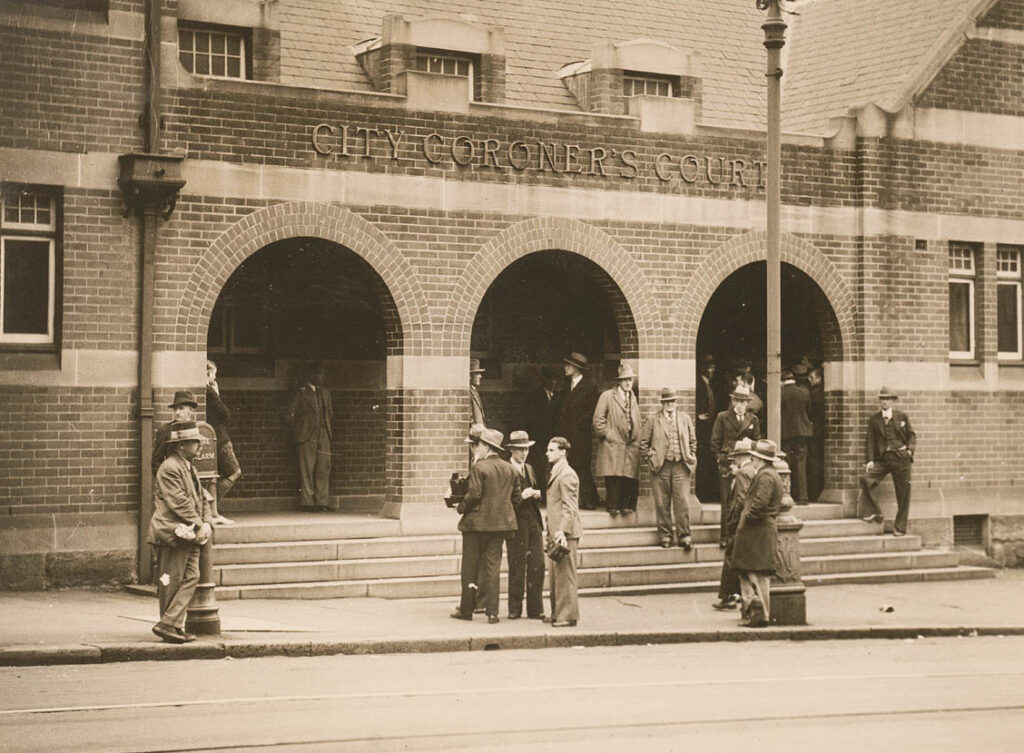
At the conclusion of the inquest, the Coroner found that Kennedy had died from injuries inflicted by Frederick Reardon and that Esther Eggers had aided and abetted him. Both were committed to stand trial for wilful murder.
The finding suggests that the Coroner accepted the police reconstruction despite its obvious gaps. Reardon had allegedly possessed Kennedy’s notebook, lied about his movements and been seen with Eggers near the area. Smith claimed to have watched the pair assault and rob a man. Starkie described a similar robbery earlier in the evening. Taken together, the evidence created a strong impression that Reardon and Eggers were engaged in violent street robbery on the night Kennedy died.
But a Coroner’s committal did not require the same level of certainty as a criminal conviction. The Attorney-General still had to determine whether a jury could properly find the accused guilty beyond reasonable doubt.
The Crown decided it could not.
The Murder Charge Abandoned
On 17 August 1922, the murder prosecution was abandoned. The Attorney-General declined to file a bill on the evidence presented at the Coroner’s Court. Contemporary reports described the evidence as unconvincing and suggested that the decision was not unexpected.
The precise legal reasoning was not published, but the evidentiary weaknesses are apparent. No witness identified Kennedy with the accused. No forensic evidence connected them to the bottle. Smith’s victim recovered and returned with a policeman, while Kennedy died from a catastrophic head injury. The assault occurred at Terry and Foveaux Streets, while Kennedy was found in a cart dock off Sophia Street. The notebook connected Reardon to Kennedy’s property but not necessarily to his death.
The Crown could prove suspicion, opportunity and possible possession of stolen property. It could not prove murder.
The Trial of the Unknown Man
Rather than abandon the matter entirely, prosecutors charged Reardon and Eggers with assaulting an unidentified man with intent to rob him. This was the assault May Smith claimed to have witnessed.
The shift was legally and historically significant. It demonstrated that the authorities no longer treated Smith’s victim as Kennedy. The man had no name, could not be produced as a witness and had not been located. The case depended primarily on Smith’s testimony.
At the first trial, Smith repeated her account. Under cross-examination, she admitted that police had later shown her a man who merely resembled the victim. She could not swear that he was the same person. This concession reinforced the uncertainty surrounding the incident.
The defence again emphasised her failure to intervene, the absence of the victim and weaknesses in identification. Reardon claimed that the alleged victim had selected another man during an identification procedure. He also accused police of persecution and interference with his employment.
The jury could not agree. Reardon and Eggers were released pending a second trial.
Conviction at the Retrial
At the retrial, Reardon represented himself and called several witnesses in support of an alibi. Other witnesses testified about alleged police interference in his employment and threatening conduct by detectives. The Crown responded by revealing his substantial criminal history and calling evidence that he had returned to his lodging house around 10.35 or 10.45 p.m., intoxicated.
After a short deliberation, the second jury found both defendants guilty of assault with intent to rob. Reardon was sentenced to eighteen months’ hard labour, while Eggers received nine months’ light labour.
The convictions suggest that the jury accepted the essential core of Smith’s evidence: that Reardon and Eggers had assaulted an unidentified man in the Terry Street area. They do not establish that every detail she gave was accurate. Most importantly, they do not connect that assault to Kennedy.
Was May Smith Lying?
The surviving evidence does not justify a conclusion that Smith invented the assault. Reardon and Eggers were eventually convicted, and her account remained broadly consistent in its central features. It is likely that she genuinely observed an attack.
The problem was not necessarily deliberate dishonesty. The problem was the use made of her evidence. Police and the Coroner appear to have treated an assault upon an unknown man as the fatal assault upon Kennedy, despite Smith’s own statement that the man later got up and returned with a policeman.
Her evidence also contained uncertainties. She could not say whether Eggers had her hand in the victim’s pocket or an arm around him. She could not determine whether Reardon used a bottle or his fist. She could not identify the victim. Her timing varied slightly between reports. Her allegation that she had witnessed the accused commit a dozen previous assaults was uncorroborated. She claimed to observe pervasive crime but rarely reported it. At the later trial, she could not swear that a man shown to her by police was the victim.
Some of these variations may reflect imperfect newspaper transcription rather than changes in Smith’s testimony. Others are ordinary limitations of eyewitness observation at night. Yet collectively they made her an unsafe foundation for a murder conviction.
The decisive inconsistency remained the fate of the victim. Smith’s man walked away. Kennedy did not.
An Investigation Shaped by Place
The Sophia Street investigation cannot be understood without considering the reputation of western Surry Hills. Newspapers portrayed Terry, Sophia and Upton Streets as a landscape of darkness, concealed doorways, sly-grog shops, prostitution, gambling and habitual robbery. Smith’s description fitted perfectly within this narrative.
That reputation may have helped police identify genuine offenders, but it also encouraged assumptions. Reardon and Eggers were known to police, active in the district and apparently involved in robberies. Kennedy had been murdered nearby. It was tempting to conclude that they must have killed him.
The case demonstrates the danger of allowing a plausible social narrative to substitute for direct proof. The accused may have committed violent robberies that evening. Reardon may have possessed Kennedy’s notebook. Yet neither circumstance established that they struck the fatal blow in the Sophia Street dock.
It is also possible that Kennedy encountered another group of offenders. The violence described by Smith was not confined to Reardon and Eggers. She portrayed robbery as a routine activity carried out by multiple groups. If her description of the neighbourhood was accurate, there were many potential attackers.
Mystery Unsolved
By May 1924, Truth was listing Kennedy’s death among the notorious murder mysteries that had baffled the New South Wales Criminal Investigation Department. Its summary was blunt: Kennedy had been bashed near Central Station, police had arrested a man and woman, the Coroner committed them for trial, but the Crown decided there was no case. The mystery remained unsolved.
The article treated the investigation as part of a wider pattern in which detectives made dramatic arrests only for prosecutions to collapse when tested against the requirements of criminal proof. Its criticism was exaggerated and theatrical, but its conclusion concerning Kennedy was correct.
Reardon and Eggers were convicted criminals. They were found guilty of assaulting an unidentified man on the night of Kennedy’s death. They may also have robbed Kennedy or come into possession of his property. Yet the surviving evidence does not prove that they murdered him.
The central witness saw the wrong man—or, at the very least, a man who could never be shown to have been Kennedy.
Francis Charles Kennedy’s final movements therefore remain unknown. He left Ashfield, travelled into the city and entered the dark streets west of Central Railway Station. At some point he was robbed and struck beneath the jaw. He fell heavily onto concrete and died alone in the Sophia Street cart dock while rain soaked his clothes and scattered possessions.
His widow identified his notebook in a crowded courtroom, but she never learned who had taken it or who had delivered the fatal blow. The Coroner believed the case had been solved. The Attorney-General recognised that it had not. More than a century later, the contradiction at the heart of May Smith’s evidence remains the key to understanding why the Sophia Street murder passed from apparent solution into enduring mystery.
References
Evening News. (1922, June 20). Railway porter found dead in Surry Hills. Evening News (Sydney, NSW : 1869–1931), p. 1. http://nla.gov.au/
Evening News. (1922, July 26). William Williamson sentenced. Evening News (Sydney, NSW : 1869–1931). http://nla.gov.au/
Maitland Daily Mercury. (1922, June 20). Surry Hills mystery: Death of Francis Kennedy. No arrest made yet. Maitland Daily Mercury (Maitland, NSW : 1894–1939), p. 2. http://nla.gov.au/
Sun. (1922, June 20). Police search for men seen with Kennedy. Sun (Sydney, NSW : 1910–1954). http://nla.gov.au/
Sun. (1922, June 24). Police seek evidence in Surry Hills murder. Sun (Sydney, NSW : 1910–1954). http://nla.gov.au/
Sun. (1922, July 17). Tragedy and pathos: How did Kennedy die? Widow’s painful ordeal at inquest. Young woman shouts denial at court. Sun (Sydney, NSW : 1910–1954), p. 7. http://nla.gov.au/
Sun. (1922, July 18). Surry Hills nights: Terrors of Terry and Upton Streets. Dressmaker defies toughs. Sun (Sydney, NSW : 1910–1954), p. 7. http://nla.gov.au/
Sun. (1922, August 17). Abandoned: Murder charge in Surry Hills case. Alleged assault. Reardon and Eggers released on bail. Sun (Sydney, NSW : 1910–1954), p. 9. http://nla.gov.au/
Sun. (1922, October 26). Unknown man: “Knocked by bottle.” Couple on trial. Sun (Sydney, NSW : 1910–1954), p. 10. http://nla.gov.au/
Sydney Morning Herald. (1922, June 20). Death of railway porter. Sydney Morning Herald (Sydney, NSW : 1842–1954). http://nla.gov.au/
Sydney Morning Herald. (1922, June 22). Three held in Surry Hills inquiry. Sydney Morning Herald (Sydney, NSW : 1842–1954). http://nla.gov.au/
Sydney Morning Herald. (1922, June 26). Murder charge. Sydney Morning Herald (Sydney, NSW : 1842–1954). http://nla.gov.au/
Sydney Morning Herald. (1922, June 30). Murder charge against two. Sydney Morning Herald (Sydney, NSW : 1842–1954). http://nla.gov.au/
Sydney Morning Herald. (1922, July 18). Surry Hills murder inquiry. Sydney Morning Herald (Sydney, NSW : 1842–1954). http://nla.gov.au/
Truth. (1922, June 25). The Surry Hills murder. Truth (Sydney, NSW : 1894–1954). http://nla.gov.au/
Truth. (1922, July 2). Search for evidence in Surry Hills murder. Truth (Sydney, NSW : 1894–1954). http://nla.gov.au/
Truth. (1922, July 23). Surry Hills murder inquiry. Truth (Sydney, NSW : 1894–1954). http://nla.gov.au/
Truth. (1922, July 23). The cart-dock crime: Terrible tale of dark doings. Brother and sister charged with the murder. Striking and pathetic testimony at Coroner’s Court. Truth (Sydney, NSW : 1894–1954), p. 7. http://nla.gov.au/
Truth. (1922, August 20). Killing of Kennedy: Problem still unsolved. Crown abandons the murder charge. Truth (Sydney, NSW : 1894–1954), p. 4. http://nla.gov.au/
Truth. (1922, October 29). “Name unknown”: Brother and sister in dock. Female Crown witness confesses fear. Truth (Sydney, NSW : 1894–1954), p. 12. http://nla.gov.au/
Truth. (1922, November 26). Underworld upheaval: Sordid story from Surry Hills. Esther Eggers and brother Fred found guilty. Truth (Sydney, NSW : 1894–1954), p. 5. http://nla.gov.au/
Truth. (1924, May 25). Our efficient C.I.D.: Murder mysteries that baffled and bogged the sleuths. Truth (Sydney, NSW : 1894–1954), p. 11. http://nla.gov.au/